Las Vegas, Nevada, is a vibrant and competitive landscape where unique branding is essential to stand out. We understand that for many businesses, the key to sustainability and growth is capturing local market attention across various locations. Local Search Engine Optimization (SEO) is the primary vehicle for this, offering multiple ways to improve your digital footprint. When local customers perform searches for services you offer, we want to ensure you appear in the top search results.
However, in our experience as a leading Las Vegas SEO company, we frequently see companies across varied markets—from entertainment to professional services—struggle to capture meaningful rankings. Often, these struggles are not due to lack of effort but because of specific, avoidable seo mistakes that others in your industry might overlook. These mistakes, such as a lack of high-quality backlinks or failing to answer common customer questions, limit your online visibility. This means potential customers are finding the competition instead of you.
This extensive guide is based on our research and analysis of thousands of local business profiles. Our team has compiled this comprehensive list of common local seo problems, providing actionable insights to help you avoid these pitfalls and maximize your local search presence. We analyze the data, identify the issues, and provide the direct fixes to help your business thrive. We will examine the most critical areas where las vegas businesses falter, ensuring your brand’s local relevance is indisputable.
Poor Foundation in Google Business Profile Setup
For most local businesses in the United States, your Google Business Profile (formerly Google My Business) is the foundation of your local visibility. Failing to optimize this platform is one of the single largest errors a business can make, often resulting in lost money and missed opportunities. We find that many companies create a listing and then essentially abandon it, leaving it to someone else or simply forgetting that it requires a consistent seo strategy to thrive. This is a critical mistake because a stagnant profile lacks the updated knowledge and fresh messaging that modern consumers expect. We encourage you to treat your profile as a living asset by regularly uploading high-quality images and responding to customer comments to build community trust. By proactively managing your profile, you influence your overall ratings and ensure your business appears active and reliable to the local audience.
Inaccurate or Inconsistent Contact Information is a Significant Problem
The most fundamental data point Google needs about your business is your NAP: Name, Address, and Phone number. We cannot emphasize this enough: accuracy and consistency are paramount. If your address is listed differently on Yelp, your own website, and your Google Business Profile, you are sending negative signals to search engines. This creates confusion and erodes trust. Users may try to find you and arrive at an incorrect location, leading to a direct loss of business. We use sophisticated tools to monitor and maintain accurate NAP information across the web for our clients.
Missing or Incorrect Categories Kill Ranking Potential
When setting up your profile, you must select primary and secondary business categories. This tells Google what you do. We often find businesses choosing either too broad or too restrictive categories. This impacts your ranking in highly specific searches. For example, a plumber in Las Vegas should use more specific service descriptors, not just “home services.” Google updates these categories periodically, and failing to review them means missed opportunities. If you are unsure, we analyze competitors in your specific niche to see which categories they leverage.
Profiles Often Lack Essential Service or Product Details
A blank Google Business Profile does you zero favors. Your profile is a sales tool, and we encourage you to maximize every field. We find countless profiles missing a robust business description, lists of individual services or products, and—critically—high-quality photos and videos. These visual elements dramatically increase engagement rates. Profiles with photos see significantly more requests for driving directions and clicks through to their website. This is a quick and effective optimization that many people overlook.
Poor Citation and Directory Management
A citation is any online mention of your business NAP and business data. We view citations as digital votes of confidence that strengthen your credibility and google maps presence. While your Google Business Profile is the most important one, it is not the only one; many Las Vegas businesses fail to properly manage their broader citation presence, creating fragmented business profiles that harm their authority. To fix this, we implement specific seo strategies that include proper link building and a logical site structure with clear headings to help search engines. Our tips for local dominance also include using localized ads to supplement organic growth, ensuring that every mention across the web reinforces your brand’s reputation and search performance.
Inconsistent Business Directory Listings Confuse Search Algorithms
Consistency across your major and minor local directories (like Yelp, Yellow Pages, and industry-specific sites) is critical. When we perform a local seo audit for a new client, one of the first things we look for is conflicting nap information. Google’s algorithm cross-references this data. Discrepancies reduce the trustworthiness of your core data, making it less likely that your business will be prioritized in local results. Correcting these errors is a primary step in our local strategy execution.
Businesses Neglect Opportunities Beyond Major Citations
While Google and Bing are key, local relevance is built on deeper connections. Many companies overlook niche, hyperlocal opportunities. For a Las Vegas business, this might mean a listing with the local Chamber of Commerce, neighborhood groups, or industry-specific associations (e.g., a real estate brokerage on a local Las Vegas neighborhood-specific portal). These focused listings provide strong local context signals that generalized platforms cannot match.
Lack of a Robust Content Strategy
“Local SEO” is often misinterpreted as just profile management. However, we consider your website’s content to be a vital extension of your local strategy. Many local websites have excellent technical seo but lack meaningful content that connects with a local audience.
Keyword Research Often Fails to Include Local Intent
General, high-volume keywords are useful, but local seo thrives on geo-targeted terms. The first major seo mistake we see in content creation is inadequate keyword research. You should not only be targeting “SEO services” but “Las Vegas SEO services.” It is also essential to capture broader intent queries like “las vegas seo company,” “best las vegas digital marketing agency,” or even question-based queries like “how to fix a running toilet in Henderson.” Your content must directly address the specific needs and location of your customers. We analyze the search landscape to discover the precise phrases your audience uses.
Pages Lack Neighborhood and Local Context Content
A frequent mistake is assuming that one single “about us” page with your address is enough local signal. It isn’t. To truly demonstrate local authority to Google, you must build deep local context. This means creating dedicated location pages if you serve different neighborhoods or surrounding cities (like Henderson, Summerlin, or North Las Vegas). You can also create localized blog posts or guides—like “The Best Hidden Gems in Summerlin for Coffee” or “Common Plumbing Problems for Older Las Vegas Homes.” This approach builds immense trust and relevance, establishing your brand as a local expert.
Websites Often Ignore Customer Journey and Conversion Design
We see many local sites that look professional but fail at the crucial final stage: conversions. Good traffic is pointless if visitors leave without taking action. We evaluate a site’s design and performance to ensure that clear, prominent call-to-action (CTA) buttons are present, contact forms work, and your phone number is clickable on mobile devices. Your metadata (like page titles and descriptions) should also encourage clicks, communicating unique value rather than just listing terms. User experience is directly correlated with local ranking success, and conversion path optimization is a critical fix we implement.
Neglecting Technical and Performance Factors
Identifying the top local SEO mistakes Las Vegas Nevada businesses make with Brooks Internet Marketing
At Las Vegas SEO, we view your website as the hub for all your digital marketing efforts. If this hub is broken, slow, or difficult to use, no amount of citation building will truly save your SEO performance. We closely monitor core technical metrics to prevent common errors.
Mobile Devices dominate Local Searches and Poor Experience kills Ranking
We live in a mobile-first world, and this is exponentially true for local searches. People searching for immediate solutions (“pizza near me,” “plumber in Las Vegas”) are overwhelmingly on mobile devices. We find it staggering that many local businesses still have non-responsive sites that provide a poor user experience. This is a fundamental mistake. We ensure that your site is fully optimized for mobile, loading quickly and scaling correctly on all screens. Google evaluates your mobile experience as the primary version of your site, so this must be a top priority.
Slow Page Speed Directly Impacts Local Search Rankings
Google has explicitly stated that site speed is a ranking factor. We understand that in a fast-paced environment like Las Vegas, consumers have very little patience for slow-loading sites. If your pages load sluggishly, users will bounce (leave immediately), sending a negative signal about your quality to the algorithm. We utilize various technical diagnostic tools to analyze the speed and performance of our clients’ sites, addressing any technical bottlenecks.
Essential Technical SEO Elements are Frequently Overlooked
There are dozens of small, technical errors that, when combined, create significant problems for local indexing and ranking. We commonly find issues like: missing xml sitemaps (which help search engines find all your pages); non-secure (http instead of https) configurations; broken links; and unoptimized robots.txt files. We also find that local businesses completely miss utilizing structured data markup (Schema), which is a hugely missed opportunity. Schema provides definitive context about your location, hours, and service offerings to search engines, giving your listings an immediate advantage. A thorough, professional SEO audit is non-negotiable for identifying these systemic technical issues.
Poor Management of Online Reputation and Engagement
In 2024 and beyond, your online reputation and public image are arguably your single most powerful marketing assets. Local customers and broader audiences rely heavily on reviews and various promotions before deciding on a service. Google also explicitly uses review signals and consistent location signals as key components of its local algorithm. Furthermore, integrating social media marketing into your strategy provides additional exposure for local brands, yet neglecting this area remains a critical local SEO mistake.
Businesses Fail to Actively Solicit Customer Reviews
The best reviews rarely happen by chance. We actively encourage our clients to build simple, direct review-acquisition systems. We often see businesses failing to ask for feedback, even when consumers are thrilled with the service. The first step to getting more reviews is just to ask. We help our clients integrate smooth review solicitation methods into their everyday customer interactions. A consistent flow of fresh, positive customer reviews is a potent trust builder.
Negative or even Positive Reviews are Often Left Unanswered
Failing to respond to reviews is a missed engagement opportunity and can even harm your brand reputation. At Las Vegas SEO, we see countless businesses with years of reviews and zero owner responses. Our approach to online reputation management treats review response as essential: you must thank people for their business (building trust) and address any problems professionally and with integrity. Even how you handle a negative comment can demonstrate your commitment to service. Proactive monitoring and a strategic response plan are critical.
Lack of Strategy Beyond Primary Review Platforms
While Google is king, other platforms matter. Many Las Vegas businesses fail to utilize other sites like Yelp, Facebook, or industry-specific review directories. Even when they do use them, we find they often treat all reviews the same, failing to analyze the different data these platforms provide. We help businesses develop a targeted response strategy for various platforms, ensuring a strong, professional presence everywhere their audience looks.
Neglecting Ongoing Analysis and Reporting
Local SEO is not a one-and-done project. We operate on the principle that if you are not measuring it, you cannot improve it. Yet, we frequently encounter local businesses that invest in seo efforts but have no comprehensive tracking in place. This is a crucial mistake, as it means your efforts are flying blind.
Google Analytics and Search Console are underutilized
If you don’t use Google Analytics (for traffic and conversions) and Google Search Console (for search performance and indexing issues), you are missing critical data. We find many local sites that either have these tools configured incorrectly or have zero data available at all. We rely heavily on this data to track the success of our marketing strategies and find specific areas for ongoing optimization. Without this, there is no way to calculate your return on investment (ROI).
Critical Data Tracking and Goal Setup is Often Ignored
Traffic is a leading metric, but the only metric that truly matters is leads and sales. Many local businesses stop at just tracking “visits” and fail to define and track true conversion goals. We always work with our clients to define meaningful conversion events: a filled-out contact form, a direct phone call click from mobile, or even a page view on a high-value landing page. We track the conversion path for these goals, analyzing which localized pages are driving real results. Tracking this detailed information allows for smarter budget allocation and strategy refinement.
Failing to Monitor and Respond to Google Algorithm Updates
Google updates its core and local algorithms hundreds of times a year. A change in the algorithm can have a massive impact on your local rankings, causing sudden spikes or drops in traffic. We find that most local businesses are completely unaware when these updates happen. This lack of awareness leaves them vulnerable to failure. We constantly monitor the SEO landscape to stay informed about these changes, so we can pivot our strategies and quickly correct any sudden problems for our clients.
A Different Approach to Local Las Vegas SEO
Avoiding these common mistakes is a significant victory, but it is just the starting point. We view local SEO as part of a holistic, multi-channel digital marketing strategy. Our core objective as your seo agency partner is to ensure your business does not just “exist” on the map, but actively competes and grows. We understand that your ultimate goals are not high search metrics, but leads, sales, and genuine business growth.
We analyze the complex web of local signals to build you an unshakeable local presence. We do not just build a strategy; we focus on execution and monitoring. We measure performance by real business outcomes, not just abstract numbers.
We leverage sophisticated local keyword analysis to capture customers with direct intent. We do not just correct listings but leverage every field for maximum profile strength. We don’t just write blogs but build localized assets that demonstrate authority to both search engines and humans. Our deep technical audits find and fix every single error holding you back. This relentless, multifaceted approach is what provides our clients with a distinct competitive advantage.
We see the tremendous potential in local Las Vegas markets, but too many businesses are held back by preventable seo issues. This guide has laid out the path to local search success. Now, it’s about taking the necessary action. We look forward to helping you navigate this journey. We invite you to contact our team to discuss how we can correct your SEO, enhance your online reputation, and provide you with a sustainable, profit-driving competitive strategy.
Frequently Asked Questions (FAQs)
1. Is local SEO a one-time effort or an ongoing process?
Local SEO is an ongoing process, not a one-time task. Search rankings change frequently due to competition, algorithm updates, and customer behavior. To maintain and improve visibility, businesses need to consistently update their content, manage reviews, monitor performance, and refine their strategy over time.
2. Do I need a website if I already have a Google Business Profile?
Yes. While a Google Business Profile helps visibility, a website builds authority, supports rankings, and converts visitors into customers.
3. How important are backlinks for local SEO?
Backlinks remain a major ranking factor. High-quality, locally relevant backlinks can significantly boost your authority and local search visibility.
4. Can social media activity impact local SEO rankings?
Indirectly, yes. Social media increases brand awareness, traffic, and engagement, which can support your overall SEO performance.
5. What is local schema markup and why does it matter?
Local schema markup is structured data that helps search engines understand your business details (like location, hours, and services), improving how your business appears in search results.
6. How often should I update my Google Business Profile?
You should update it regularly—at least weekly or biweekly—with posts, photos, offers, and business updates to keep it active and engaging.
7. Does voice search affect local SEO strategies?
Yes. Many local searches now come from voice queries, which tend to be more conversational and question-based, making long-tail keywords increasingly important.
8. How do I track phone call conversions from local SEO?
You can use call tracking tools or Google Business Profile insights to measure how many calls are generated from your local listings.
9. Should I create separate pages for each service area?
Yes, if done correctly. Dedicated pages for each location or neighborhood can improve relevance and rankings for geo-specific searches.
10. What should I do if my local rankings suddenly drop?
First, check for algorithm updates, technical issues, or listing inconsistencies. Then review competitors and any recent changes to your site or profile to identify possible causes.
If you’re a business owner in Las Vegas, NV, showing up in Google’s local search results can mean the difference between getting steady leads, or losing customers to competitors.
When someone searches for “plumber near me,” “best med spa in Las Vegas,” or “lawyer in Las Vegas,” Google often displays a map pack at the top of the page. This section highlights three local businesses and drives a large percentage of phone calls and website visits.
Your position in that map pack is heavily influenced by how well your Google Business Profile (GBP) is optimized.
In this guide, we’ll walk through exactly how Vegas businesses can optimize their Google Business Profile, specifically to Las Vegas, Nevada, to improve visibility, rankings, and conversions in 2026.
What Is a Google Business Profile (GPB)?
A Google Business Profile is your official business listing on Google. It appears in:
For local SEO in Las Vegas, your GBP is literally the most important asset that your business owns for map pack rankings!
Why Your Google Business Profile Matters for Las Vegas Businesses
Las Vegas is one of the most competitive local markets in the country. Businesses compete with:
National brands
Tourist-focused companies
High-ad-spend competitors
Aggressive local agencies
Additionally, if you think of the cities in other areas, like Southern California for instance, they have small cities everywhere, so it is much easier to rank in those small cities with much less competition. Las Vegas only has Las Vegas, North Las Vegas, and Henderson as incorporated cities, and that’s it! Green Valley and Summerlin, etc. are not incorporated cities. So there is much greater competition in Las Vegas than in other places of the country. Because of this, Google relies heavily on local signals to decide which businesses deserve top visibility.
An optimized Google Business Profile helps you:
✔ Appear in map pack results
✔ Get more phone calls
✔ Drive website traffic
✔ Build trust with reviews
✔ Improve local rankings
If your profile isn’t optimized, you’re leaving money on the table.
Step 1: Claim and Verify Your Business Profile
Before optimization begins, make sure your business is claimed and verified. Sometimes a profile may exist because Google created it for you even if you did not create your business listing. Unclaimed listings are difficult to optimize and offer no level of trust to Google because no one has claimed it.
If you haven’t created or claimed your Las Vegas GPB listing yet:
Verification is usually done via postcard, phone, or a video verification requiring business documentation.
Without verification, your profile won’t rank consistently.
Step 2: Ensure Las Vegas NAP Consistency (Name, Address, Phone)
NAP consistency is critical for local SEO.
Your Las Vegas business information must match exactly across:
Google Business Profile
Your website
Directories
Social media profiles
For example:
❌ “Brooks Internet Marketing, LLC”
❌ “Brooks Internet Marketing”
❌ “Brooks Internet Mktg”
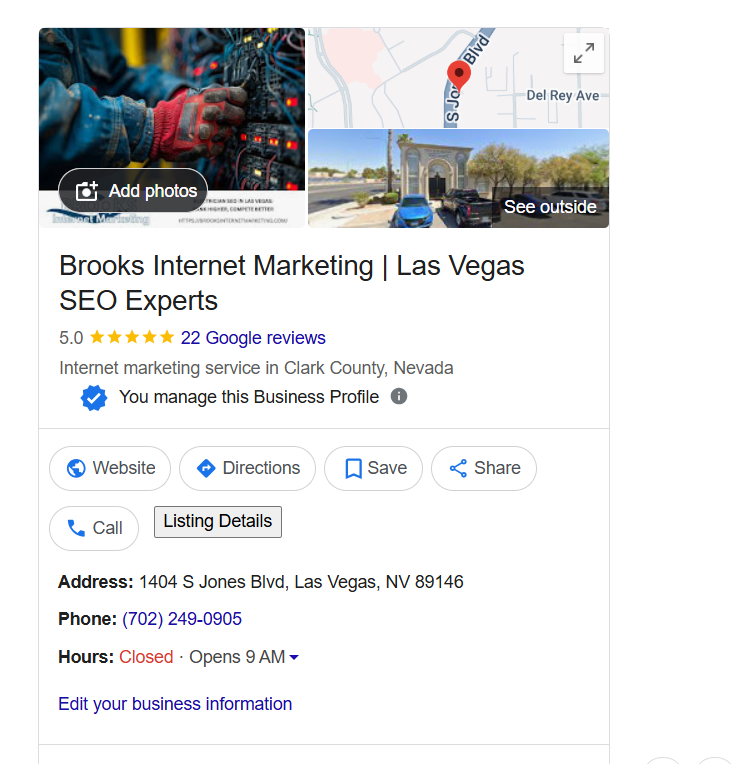
✅ Brooks Internet Marketing | Las Vegas SEO Experts
You want it exactly as it appears on Google, everywhere else:
Variations confuse Google.
Use one standardized format everywhere.
Step 3: Choose the Right Primary and Secondary Categories
Your categories tell Google what your business actually does.
Primary Category (Most Important)
Choose the category that best represents your main service.
Examples:
Marketing Agency
SEO Service
Law Firm
Medical Spa
HVAC Contractor
This has a major impact on rankings.
Secondary Categories
Add relevant secondary categories that support your services, but don’t overdo it.
Example for an SEO agency:
Internet Marketing Service
Marketing Consultant
Advertising Agency
Avoid irrelevant categories.
Step 4: Write a Keyword-Optimized Business Description
Your business description should:
✔ Explain what you do
✔ Mention Las Vegas naturally
✔ Include services
✔ Highlight value
Example:
“Brooks Internet Marketing provides professional SEO, local search optimization, and digital marketing services for businesses in Las Vegas and surrounding areas. We specialize in helping companies improve search visibility, generate leads, and grow revenue through proven online strategies.”
Do not stuff keywords.
Keep it natural.
Step 5: Add High-Quality Photos and Videos
Businesses with strong visual profiles tend to get more engagement.
Upload:
Office photos
Team photos
Exterior signage
Interior shots
Work examples
Branded graphics
Tips:
✔ Use high resolution
✔ Name files descriptively
✔ Update regularly
✔ Add new images monthly
Fresh content signals activity to Google.
Step 6: List Your Services and Products
Use the “Services” section to list exactly what you offer.
Examples for service businesses:
Local SEO
Website optimization
Google Ads management
Content marketing
Each service should include:
Clear title
Short description
Target keywords
This improves relevance.
Step 7: Build and Manage Customer Reviews
Brooks Internet Marketing delivers proven Google Business Profile optimization strategies for businesses targeting Las Vegas, Nevada searches in 2026
Reviews are one of the strongest local ranking factors.
How to Get More Reviews
Ask happy clients directly
Send follow-up emails
Provide review links
Include review requests in invoices
Never buy fake reviews.
That can get your profile suspended.
How to Respond to Reviews
Respond to:
✔ Positive reviews
✔ Neutral reviews
✔ Negative reviews
Example response:
“Thank you for your feedback. We appreciate the opportunity to work with you and are glad we could help.”
This builds trust and engagement.
Step 8: Use Google Posts Weekly
Google Posts allow you to publish updates on your profile.
Post:
Promotions
Blog updates
Announcements
Case studies
Tips:
Aim for at least 1 post per week.
This shows Google your business is active.
Step 9: Optimize for Las Vegas Neighborhoods
If you serve multiple areas, reference them naturally:
Summerlin
Henderson
North Las Vegas
The Strip
Downtown
Use them in:
Website content
Service pages
Google Posts
Business description
This helps with proximity-based searches.
Step 10: Track Performance and Optimize Monthly
Monitor your profile inside Google Business Profile Insights.
Track:
Searches
Calls
Website clicks
Direction requests
Photo views
Use this data to improve your strategy.
Local SEO is ongoing, not one-time.
How Google Business Profile Supports Your Overall SEO Strategy
Your GBP works best when combined with:
Strong website SEO
Quality content
Backlinks
Technical optimization
For businesses serious about growth, professional guidance is often necessary.
Learn more about our Las Vegas SEO services and how we help businesses dominate local search results.
Need Help Optimizing Your Google Business Profile?
Optimizing a Google Business Profile takes time, strategy, and consistency, especially in a competitive market like Las Vegas.
At Brooks Internet Marketing, we help businesses:
✔ Rank in Google Maps
✔ Increase local leads
✔ Improve visibility
✔ Build long-term authority
If you’d like expert support, schedule a free consultation today.
In a competitive market like Las Vegas, standing out in search engine results requires more than a general SEO strategy. Today’s savvy searchers are looking for services, products, and businesses not just by city but by neighborhood, zip code, or even street-level proximity. That’s where geo-targeting SEO becomes essential—not only for reaching your local audience but also for guiding your outreach strategies, earning relevant links, and staying ahead of emerging trends across all cities in your service area.
At Las Vegas SEO, we’ve helped countless businesses dominate their local market by leveraging targeted, data-driven search engine optimization strategies tailored to specific locations, communities, and service areas across the Las Vegas Valley. Through focused searches, proven methods, and a deep understanding of how the algorithm impacts local sites, we’ve driven measurable success, attracting more visitors, increasing conversions, and delivering results. Whether you’re looking for more leads, more calls, or just a lot more visibility, our tailored SEO services can help you achieve great things, one neighborhood at a time.
This comprehensive guide will walk you through the exact steps, tools, and strategies needed to rank in multiple Las Vegas neighborhoods, improve your visibility, and turn searchers into loyal customers. Whether you’re building a high-converting landing page, refining your target keywords, or improving direction for each client, this resource provides actionable tactics that lead to a strong local result. In every instance, our goal is to help your business succeed where it matters most.
Table of Contents
Understanding Geo Targeting SEO
Geo-targeting SEO is the process of optimizing your website, content, and online presence to rank for search queries tied to specific locations. For example, instead of just optimizing for “SEO agency Las Vegas,” you optimize for:
“SEO agency in Summerlin”
“Search engine optimization in Downtown Las Vegas“
“SEO company near Spring Valley”
This approach helps your business appear more relevant to users searching for services in their immediate area, increasing the likelihood of clicks, conversions, and sales. With the right mindset and strategic implementation of tools like email marketing, localized content, and a strong digital platform, your brand gains a significant advantage. Choosing the right words and highlighting clear benefits tailored to each neighborhood further boosts your visibility and engagement.
Why Localized SEO Is Critical in Las Vegas
Las Vegas isn’t just one city—it’s a patchwork of diverse neighborhoods, each with unique demographics, interests, and business needs. From Summerlin to Henderson and Paradise to North Las Vegas, users are searching for service providers, restaurants, stores, and other businesses near their location. That’s why mastering local SEO is of critical importance—it allows your brand to connect with hyper-targeted audiences right where they are most likely to purchase. Following best practices in localized optimization not only increases your exposure but also helps you stand out in a crowded place. While global countries may compete online, it’s local relevance that wins in Las Vegas.
Here’s why geo-targeted SEO techniques work in Las Vegas:
Increased visibility in local search results
Higher engagement and conversions
Better alignment with searcher intent
Enhanced brand awareness in key areas
More qualified traffic from people who are ready to buy
Step-by-Step Strategy to Rank in Multiple Neighborhoods
1. Create Individual Location Pages
One of the most essential elements in geo-targeted SEO is building location-specific landing pages. Instead of just one generic page, create separate pages for each neighborhood you serve. The importance of this approach lies in its effectiveness—it allows you to tailor your message to what someone in that area is searching for. Include details about services, testimonials, and local landmarks to make each page feel authentic. If you’ve run a successful campaign in one area, consider replicating the strategy for another. Always be prepared to answer common questions your local audience may have, which will boost trust and engagement.
For example:
/Summerlin-seo-services
/downtown-las-vegas-seo-company
/Henderson-SEO-consulting
These pages should include:
Unique content with keywords for that area
Explicit descriptions of your services
Local photos, images, and videos
NAP (name, address, phone number) for that location
Embedded map and directions
Local reviews, testimonials, and citations
Don’t forget to include relevant alt text, meta descriptions, and structured data to help search engines index your location pages correctly. The effectiveness of this step is supported by the fact that many industries and markets have experienced significant improvements in local rankings through the optimization of these elements. At times, even adding the city name to your metadata can make a difference. Whether you’re a small business or a growing SEO company, staying ahead with AI-driven tools and best practices can elevate your visibility. This article serves as a reminder that minor optimizations in local SEO can yield significant results.
2. Optimize Your Google Business Profile
Google Business Profiles (formerly known as Google My Business) are a cornerstone of local SEO strategies. To rank across multiple neighborhoods, optimize your listing for each location with precise specifics about the regions you serve. A strong website design that links to these profiles also improves trust and credibility. One reason many businesses fall short is that they fail to utilize these powerful resources to their full potential. Whether you’re targeting Las Vegas or even branching into Los Angeles, consistency and relevance are key. Use this opportunity to test new ideas, monitor your return on investment (ROI), and refine your local presence for maximum visibility.
What to include:
Exact business name
Relevant business category
Service description using local keywords
Phone number, website, address
Local photos and videos
Reviews and responses
Frequent updates, events, and offers
Additionally, ensure consistent NAP data across directories such as Yelp, Yellow Pages, Facebook, and Bing Places. Consistency enhances trust, credibility, and ranking signals—essential for driving conversions and engagement with local consumers. Many brands overlook the impact of this detail, but it can influence both user trust and advertising performance. Making informed decisions about your local SEO strategy requires expertise, especially when trying to stay on top of search results and stand out from competitors.
3. Use Structured Data for Local Business
Implement schema markup on all location pages using the LocalBusiness schema. This helps Google, Bing, and other search engines understand your business information, location, service area, and keywords. It also clarifies essential details, such as your product offerings, contact information, and relevance to your target audience. Whether you’re a single-location business or part of a larger franchise, schema markup ensures your presence is clearly understood at the state level and beyond. If you’re looking to stand out, this is something you shouldn’t overlook.
Tools like Google’s Structured Data Testing Tool and SEMrush can help validate your schema and ensure that business listings are properly formatted across your region. Clean, consistent URLs, intuitive navigation, and accurate markup not only improve SEO but also enhance the customer experience. When your pages and business information align correctly, search engines and users alike provide better feedback—and your listings support each other in building stronger overall visibility.
4. Invest in Hyperlocal Content Marketing
Publishing content targeted at specific neighborhoods helps build relevance and authority. Following guidelines for local SEO and leveraging social media profiles can amplify your reach while encouraging feedback from local audiences to support credibility and growth. No matter the type of business, having a strong presence across the internet is essential—and if you’re not optimizing for local intent, you’re likely missing out on anything meaningful to your nearby customers.
Create blog posts, articles, and landing pages about:
Local events, guides, and opportunities
Interviews with local influencers or clients
Case studies about specific areas
Neighborhood-focused SEO tips
Example titles:
“How Henderson Businesses Can Use SEO to Grow in 2025”
“Top 5 SEO Strategies for Summerlin Restaurants“
“Why Your Spring Valley Store Needs a Google Maps Presence”
Use keywords related to the location, services, and industry. Include photos, maps, and community references to build engagement and increase views. In this section of your local SEO strategy, the role of localized content marketing becomes clear—it highlights your relevance within specific boundaries and neighborhoods. Incorporating keyword variations and emphasizing the unique value your business brings to each area can make a significant impact, even on a limited budget.
5. Earn Backlinks from Local Sources
Local backlinks are potent for geo-targeted SEO. Reach out to:
Local bloggers, journalists, and publications
Chambers of commerce or business directories
Community websites and event listings
Clients, partners, or local influencers
Backlinks improve authority and trust and boost your chances of outranking competitors in nearby areas.
Use tools like SEMrush, Ahrefs, or Moz to track your link-building progress and discover new opportunities.
6. Leverage Social Media & Engagement Signals
Local SEO is impacted by engagement, reputation, and social proof. Boost your presence by:
Posting local updates on Instagram, Facebook, and LinkedIn
Running local ads targeting specific zip codes
Sharing blog posts about Las Vegas neighborhoods
Adding location tags to all photos and videos
Collecting and responding to reviews on Yelp, Google, and other platforms
This builds relevance, improves SEO rankings, and enhances your brand’s presence across the city.
7. Track Performance & Update Frequently
Use analytics to monitor:
Traffic by location
Local keywords and search volume
Page performance and rankings
Mobile vs. desktop user experience
Conversions and sales by area
Update your content, keywords, and listings regularly to stay competitive and maintain a strong online presence. Local algorithms change frequently, and staying current gives you an edge in the search engine landscape. Regular optimization supports your overall SEO strategy, boosts your visibility, and drives more targeted traffic to your location pages. By monitoring analytics, understanding your demographics, and keeping your business category aligned with your offerings, you enhance your relevance in every map search. Effective marketing in competitive markets means continuously refining your efforts to connect with your audience, adapt to competition, and strengthen your position in local search results.
Examples of Local SEO in Action
Let’s look at some real-world examples of geo-targeting for businesses in Las Vegas:
A restaurant in Downtown Las Vegas created a separate location page. It gained 300% more search visibility after being listed on Google Maps and optimizing for the search term “best tacos in downtown Las Vegas.”
An eCommerce store offering same-day delivery launched landing pages for Summerlin, Henderson, and North Las Vegas. This boosted local traffic by 140% and increased revenue.
A B2B SEO agency in Spring Valley partnered with local publications to boost backlinks and rank on the first page for “Spring Valley digital marketing.”
These cases demonstrate the significant impact of geo-targeted SEO when combined with the right strategy, tools, and consistent effort. By aligning keywords, content, and outreach with the specific needs of a target audience, businesses can significantly enhance visibility, increase traffic, and strengthen their online presence across both desktop and mobile platforms. Optimized listings, local backlinks, and innovative map usage help navigate tight competition while understanding demographics, monitoring analytics, and tracking trends to ensure lasting relevance. When your location-based marketing efforts are guided by current algorithms and focused on genuine engagement, the long-term impact is measurable and sustainable.
Brooks Internet Marketing creates geo targeting SEO strategies for businesses in Las Vegas Nevada to improve neighborhood rankings
Common Geo-Targeting Mistakes to Avoid
To maximize your SEO efforts, steer clear of these mistakes:
Duplicating content across location pages
Failing to list accurate business information
Ignoring mobile optimization
Not leveraging citations, directories, and reviews
Overstuffing keywords or missing out on long-tail keywords
Skipping updates, testimonials, and photos
Focus on quality, relevance, and user experience to avoid penalties and improve search rankings.
Tools to Help You Win Local SEO
These platforms can support your geo-targeting strategy:
SEMrush – Keyword research, site audits, competition analysis
BrightLocal – Citation tracking, local audit reports
Google Analytics – Traffic insights by location
Google Search Console – Keyword and ranking data
Ahrefs – Backlink tracking and competitor insights
Moz Local – NAP consistency and directory management
These tools help you monitor performance, optimize pages, and maintain a strong presence across all neighborhoods.
Local SEO Is the Way to Grow
Whether you’re a single-location store or a multi-location business, mastering geo-targeting SEO is the most powerful way to expand your reach and grow your brand in a city as dynamic as Las Vegas.
At Las Vegas SEO, we’re not just an SEO company—we’re your long-term partner in building lasting results. Our team helps you:
Design custom campaigns by area
Improve local search rankings
Increase traffic, conversions, and sales
Strengthen your reputation and authority
Ready to Rank in Every Las Vegas Neighborhood?
Get in touch with Las Vegas SEO for a free consultation. Let’s build your strategy, optimize your locations, and help your customers find you—no matter where they’re searching from.
Frequently Asked Questions
1. Can I rank in multiple Las Vegas neighborhoods using one website?
Yes, you can rank in multiple neighborhoods using a single domain, but you must create dedicated location pages with unique, locally optimized content for each area you want to target. Avoid duplicating content and make each page relevant to the specific neighborhood.
2. How many location pages should I create for my business?
There is no set limit, but you should create a separate page for each neighborhood, suburb, or service area where you actively conduct business or want to attract customers. Ensure that each page has valuable, localized information to maintain quality and SEO performance.
3. Do I need a separate Google Business Profile for each neighborhood?
You only need separate Google Business Profiles if you have distinct physical locations (with their addresses). Otherwise, use service area settings within a single profile to reflect multiple neighborhoods and zip codes you serve.
4. What type of content should I include on my neighborhood-specific pages?
Include content such as:
Services offered in that neighborhood
Local photos and testimonials
Nearby landmarks or events
Customized offers or promotions
Embedded maps and directions
This builds relevance and helps search engines and users understand your local authority.
5. Can service-based businesses without storefronts still benefit from geo-targeting SEO?
Absolutely. Service-area businesses (like contractors, consultants, and home services) can rank in multiple locations by using a well-structured location page strategy and schema markup and by clearly defining their service areas in business listings and content.
6. How do reviews impact local SEO across multiple neighborhoods?
Reviews play a significant role in trust and visibility. Encourage customers from different areas to leave reviews and mention the neighborhood they’re from. This not only builds credibility but also boosts relevance for local searches.
7. Should I use the exact keywords for every neighborhood page?
No. While some keywords may overlap, you should use neighborhood-specific variations to increase relevance. For example, instead of using “SEO services,“ use “SEO services in Summerlin“ or “SEO agency near Henderson.”
8. How long does it take to see SEO results from geo-targeting strategies?
Results vary depending on your competition, the quality of your content, the quality ofbacklinks, and optimization. However, local SEO strategies typically show results within 3 to 6 months, especially if you’re consistent with content updates and listings management.
9. Are citations still crucial for local SEO in 2025?
Yes. Citations (mentions of your business name, address, and phone number) across directories like Yelp, Yellow Pages, and niche platforms help search engines verify your legitimacy and location, boosting your local rankings.
10. How can I track the performance of my geo-targeted SEO efforts?
Use tools like:
Google Analytics (for traffic by location)
Google Search Console (for keyword impressions/clicks)
SEMrush or BrightLocal (for local visibility and rankings)
These tools help you measure the effectiveness of your strategy and adjust based on what’s working in each neighborhood.
Businesses competing in highly competitive markets like Nevada often rely on professional Las Vegas SEO services to improve their search visibility.
Attorneys in competitive markets like Las Vegas often depend on focused Law Firm SEO strategies to attract qualified clients.
In 2025, Las Vegas businesses face a rapidly evolving digital landscape that demands strategic thinking, adaptability, and comprehensive SEO implementation. As search engine algorithms become more sophisticated, businesses must focus on delivering relevant information to users through optimized content, accurate phone number listings, and clear messaging. At Las Vegas SEO, we help companies elevate their digital presence through targeted strategies such as keyword research, on-page optimization, technical SEO, backlink building, and local SEO. In a competitive area known for tourism, entertainment, and entrepreneurship, standing out in search engines requires effective branding, innovative use of media, and tailored campaigns for different areas of the city.
Every business can benefit from a well-executed search engine optimization strategy, from small local shops in Summerlin to world-renowned casinos on the Strip. Success starts with the right approach involving a skilled team, consistent updates, and technical elements like structured data and citations. Enhancing web design for usability and optimizing pages for products and services ensures stronger visibility in search results. To stay on top in the competitive Las Vegas market in 2025, businesses must embrace data-driven SEO tailored to their audience and industry.
Table of Contents
1. Understanding SEO in the Las Vegas Business Context
SEO, or search engine optimization, is increasing the quantity and quality of traffic to your website through organic search engine results. Las Vegas is home to thousands of hospitality, entertainment, real estate, healthcare, retail, law, and more businesses. With millions of local and tourist searches happening daily, investing in SEO isn’t optional—it’s essential. A strategic approach to your SEO efforts improves visibility and plays a key role in building credibility and outpacing competitors. Publishing relevant articles and offering tailored solutions can significantly enhance engagement and deliver a strong return on investment.
SEO for Las Vegas businesses must reflect the city’s fast-paced environment, seasonal trends, local intent, and industry competition. It means tailoring your web content, structure, and local listings to serve locals and out-of-town visitors. A strong marketing strategy includes user-friendly navigation, targeted content, and technical enhancements that drive SEO performance. Working with the right SEO services provider ensures continuous improvement and measurable results. Las Vegas is one of the most dynamic markets in the country, and staying visible means adapting fast and optimizing smart.
2. The Importance of Local SEO
In a city like Las Vegas, local SEO is a game changer. Many searchers are on mobile devices looking for services nearby—like “best taco restaurant on the Strip” or “emergency plumber near me.” Appearing in Google’s local 3-pack can significantly increase foot traffic and calls. To achieve this, businesses should optimize their Google Business listing, upload high-quality photos, and maintain accurate profiles across local directories. Implementing schema markup helps search engines understand your content better while building a strong backlink profile and local relationships, which enhances authority and local relevance.
Key local SEO practices:
Claim your Google Business Profile and optimize it with categories, images, hours, and services.
Keep NAP (Name, Address, Phone) consistent across platforms like Yelp, Yellow Pages, and industry directories.
Encourage customer reviews and respond professionally.
Use location-specific landing pages for Las Vegas neighborhoods (e.g., Henderson, Downtown, Paradise, Summerlin).
Google increasingly favors businesses demonstrating real-world relevance and engagement in their local market.
3. Advanced Keyword Research for Targeted Visibility
Targeting the right keywords is fundamental to ranking well. In 2025, it’s not just about volume but user intent and local context. For businesses in Nevada, especially in Las Vegas, this means identifying opportunities that resonate with locals and tourists. Crafting content that speaks to diverse audiences—from residents to visitors—requires strategic decisions and consistent effort. Effective keyword targeting supports promotions, engages the local community, and drives meaningful results aligned with business goals.
Tools for keyword research:
Google Search Console: Analyze what terms people already use to find your website.
Ahrefs, SEMrush, and Ubersuggest: Discover keyword volume, competition level, and related terms.
People Also Ask and Autocomplete: Use Google’s data for long-tail ideas.
Keyword types to target:
Transactional keywords: “book limo Las Vegas”
Informational keywords: “How to find a good lawyer in Las Vegas.”
Navigational keywords: “Bellagio buffet hours”
Balance broad keywords with long-tail terms that signal buying intent. This increases your chances of converting visitors into leads. Businesses should tailor their content to specific needs and search behaviors to connect with diverse audiences across Nevada. Enhancing your business image with accurate information on Google Maps is also key to successful local SEO. As organizations aim for continuous progress, focusing on intent-driven keywords ensures more qualified traffic and better conversion potential.
4. Content Marketing That Converts
Content is still king, but in 2025, it’s all about creating relevant, well-structured, and value-driven content. The goal is to solve user problems and position your brand as a trusted resource. Practical content marketing offers each visitor a clear solution while showcasing your business’s track record. Whether you’re targeting tourists looking for top restaurants or locals searching for services, compelling content can directly influence revenue. Collaborating with seasoned SEO experts ensures your messaging aligns with user intent and search engine requirements.
Content strategies:
Blog posts addressing common local questions (“What’s the best time to visit Las Vegas?”)
Service and product pages optimized with local modifiers
FAQ sections to reduce bounce rates
Video content and infographics to improve time on the page
City guides, how-tos, or event calendars
Content builds topical authority and gives search engines more context for ranking your website.
5. Technical SEO and User Experience
Brooks Internet Marketing delivers successful 2025 SEO strategies designed for Las Vegas, Nevada business owners
Your website’s technical health directly impacts how well it ranks.
Technical SEO priorities:
Mobile responsiveness: Over 60% of Las Vegas searches are mobile.
Site speed: Google favors websites that load in under 2 seconds.
Secure hosting (HTTPS): A must-have for user trust.
Structured data markup: Helps with rich results like FAQs, stars, events, and pricing.
Audit tools like Lighthouse, Screaming Frog, and Google PageSpeed Insights can help identify and fix issues.
6. On-Page SEO: Optimizing Every Page for Success
Every page should have a clear SEO goal and use on-page best practices:
Include your focus keyword in the H1, meta title, and within the first 100 words.
Use descriptive meta descriptions to improve CTR.
Apply internal linking to boost crawlability and user flow.
Optimize images with alt tags and compression.
Use header tags (H1, H2, H3) to structure content.
On-page SEO enhances discoverability and user experience, leading to longer sessions and more conversions. Businesses can build trust and improve search engine rankings by crafting high-quality content that grabs users’ attention and encourages clear communication. Leveraging your team’s expertise in web content, design, and social media management helps create a seamless, engaging experience that appeals to both users and search engines alike.
7. Backlink Building in a Competitive Market
Backlinks—links from other sites pointing to your content—signal trust and authority to Google. In Las Vegas, where industries like gambling, tourism, and law are competitive, backlinks are a crucial differentiator. Social media marketing and optimized Google My Business profiles help build these links organically. Effective techniques include guest blogging, local partnerships, and directory listings that feature your logo, contact info, and services. This approach benefits businesses, from retail stores to law firms, by boosting website traffic and domain authority.
Link-building tactics:
Submit guest posts to local or niche publications
Sponsor local events or charities for link mentions
Get featured in Las Vegas news outlets
Create valuable resources (e.g., city guides, statistics, tools) that others want to reference
Quality matters more than quantity. A handful of high-authority backlinks can outperform hundreds of spammy links.
8. Social Signals and SEO Synergy
While social signals aren’t direct ranking factors, they influence SEO indirectly by driving traffic and increasing brand visibility. The impact of sustained engagement through platforms like social media and email marketing can significantly boost brand recognition. Maintaining consistency in messaging and posting schedules across all digital channels supports long-term SEO growth and user trust.
Social SEO tactics:
Share blog posts regularly on Facebook, Instagram, and LinkedIn
Run geo-targeted ads for seasonal events or sales
Collaborate with Las Vegas influencers
Encourage social sharing by embedding sharing buttons
Google notices popular content mainly when it attracts backlinks, comments, and consistent engagement.
9. Reputation Management and Online Reviews
In a city like Las Vegas, word-of-mouth marketing now lives online. Positive reviews boost trust, increase conversions, and influence local rankings. At Las Vegas SEO, we understand how crucial online reputation management is for visibility. Google’s algorithm heavily weighs user reviews and engagement when determining local search positions, making online feedback more potent.
Review strategies:
Automatically follow up with customers post-purchase via email or SMS
Ask satisfied clients to review you on Google, Yelp, Facebook, and Tripadvisor
Respond to every review—positive or negative—with professionalism
Monitor your brand mentions using tools like Reputation.com or Google Alerts
Your online reputation is a key pillar of your SEO strategy.
10. Data Analytics: Measure and Improve Continuously
SEO is not a set-it-and-forget-it discipline. You must track performance and iterate based on data.
Key metrics to monitor:
Organic traffic trends
Keyword ranking improvements
Click-through rates (CTR) from SERPs
Bounce rates and session duration
Conversion rates from organic sources
Use tools like:
Google Analytics 4 (GA4) for traffic and behavior
Search Console for indexing and impressions
Hotjar for heatmaps and user journey tracking
Adjust your strategy monthly or quarterly based on what the data reveals.
11. Combining PPC with SEO
While SEO builds long-term visibility, pay-per-click (PPC) advertising offers immediate traffic. Used together, they can dominate both paid and organic real estate on the SERP.
How to combine them:
Use PPC to test keyword viability before long-term SEO investment
Target branded terms to protect your business name
Run local ads while building organic rankings
Create retargeting ads for SEO blog traffic
SEO and PPC aren’t enemies—they’re complementary tactics in a full-funnel marketing plan.
12. Working with a Las Vegas SEO Agency
Partnering with an expert SEO agency provides specialized knowledge, advanced tools, and a roadmap for sustainable growth. At Las Vegas SEO, we offer:
In-depth site audits and keyword research
Custom content strategies for your niche
Technical SEO and mobile-first design support
Link-building campaigns and influencer outreach
Conversion tracking and monthly reporting
We work with clients in law, real estate, hospitality, eCommerce, medical services, and more. Our local insight helps us create high-performance campaigns that get results.
13. Future SEO Trends to Watch in 2025
To stay ahead, Las Vegas businesses must prepare for emerging SEO trends:
Voice search optimization: Focus on conversational phrases and FAQs.
AI-generated content auditing: Ensure your content remains authentic and trustworthy.
Zero-click search growth: Optimize for featured snippets and Google’s People Also Ask.
Video SEO: Use YouTube and TikTok to dominate more visual SERPs.
User intent targeting: Move beyond keywords to satisfy search goals completely.
Being proactive rather than reactive will give your business a competitive edge.
Conclusion: SEO Success Starts Today
For Las Vegas businesses, 2025 SEO strategies must be comprehensive, user-focused, and data-driven. With fierce industry competition, the right strategy can help your business dominate the local search landscape, connect with your audience, and convert clicks into customers.
Whether you’re a startup, an established company, or a service provider, Las Vegas SEO is your trusted partner in digital growth. Let’s build your visibility, grow your leads, and put your brand on the digital map—starting today.
Frequently Asked Questions
1. How long does it take to see results from SEO in Las Vegas?
SEO results vary, but most Las Vegas businesses can expect to see noticeable improvements in 3–6 months. Highly competitive markets or brand-new websites may take longer.
2. Do I need a separate SEO strategy for tourists vs. local customers?
Yes. Tourists often use short-term, location-based searches, while locals focus on long-term service needs. Tailor landing pages and content accordingly.
3. Is voice search optimization important for Las Vegas businesses?
Absolutely. With the rise of mobile and smart speakers, optimizing for natural language queries and question-based keywords improves visibility in voice search results.
4. Should I optimize my website in multiple languages?
If your business caters to international tourists, offering multilingual content (e.g., Spanish, Chinese) can significantly boost your search rankings and user experience.
5. How important is mobile-first indexing in 2025?
Critical. Google now prioritizes mobile performance for rankings. A responsive, fast-loading, mobile-optimized site is non-negotiable for Las Vegas SEO success.
6. What role does video play in modern SEO?
Video enhances engagement and keeps users on your site longer. Embedding YouTube videos with keyword-rich titles and descriptions also improves search visibility.
7. Can negative reviews hurt my SEO rankings?
Too many unresolved negative reviews can damage local SEO. Actively manage your reputation by responding professionally and addressing concerns promptly.
8. How often should I update my website content?
Update core pages quarterly and publish new blog content at least once a month. Fresh, relevant content signals to Google that your site is active and authoritative.
9. What are citations, and why do they matter for local SEO?
Citations are online mentions of your business name, address, and phone number (NAP). Consistent citations across platforms help verify your legitimacy to search engines.
10. Do schema markups help with rankings?
Yes. Structured data helps search engines understand your site content better and enables rich results like star ratings, FAQs, and event info—boosting click-through rates.
Businesses competing in highly competitive markets like Nevada often rely on professional Las Vegas SEO services to improve their search visibility.
Law firms serving Nevada communities can improve their online visibility with specialized Las Vegas Law Firm SEO strategies.
In today’s digital-first world, local SEO plays a pivotal role in the success of small businesses. For companies located in competitive areas like Las Vegas, having a fully optimized Google Business Profile (GBP) is no longer optional—it’s essential. Whether you run a coffee shop, hotel, plumbing service, or e-commerce store, your customers search for your business online. A well-optimized GBP enhances your discoverability, boosts branding, and increases your exposure across platforms where people actively search. With access to powerful analytics, businesses can track performance and refine their strategy to improve engagement and growth.
From visibility in search results to improving your reputation and generating revenue, optimizing your GBP ensures your name, address, phone number (NAP), photos, reviews, and other critical information appear accurately across search engines like Google and Google Maps. This boosts your online presence and helps drive real-world visits and sales. The benefits of optimization are especially impactful in a densely populated area like Las Vegas, where a strategic approach can determine how your site performs on various devices. Following the proper steps, businesses gain a competitive advantage, create a compelling digital storefront, and offer more attractive options to potential customers.
Let’s dive into why Google Business Profile optimization is critical for your Las Vegas business and how Brooks Internet Marketing can help you stay ahead of the curve.
Table of Contents
What Is a Google Business Profile?
Your Google Business Profile (formerly Google My Business) is a free tool provided by Google that allows companies to manage how they appear in search engines, particularly on Google Maps and in local SEO packs. It acts as a powerful advertising platform where someone searching for your services can quickly find essential pages, see example businesses, and take the next step. For users, it’s a crucial factor in discovering local businesses, providing smooth navigation, and relevant results right when they need them. A well-optimized business profile displays crucial information like:
Business name, address, and phone number (NAP)
Operating hours
Photos and videos of the business
Customer reviews and ratings
Description of services, products, and business categories
Links to your website or booking platform
Directions and maps
These listings directly impact your ranking in local search results. When searchers use terms like “best coffee shop near me” or “Las Vegas plumber,” businesses with optimized profiles appear at the top of the map pack, increasing chances of customer engagement. A well-optimized listing enhances your brand visibility, ensures accuracy, and supports a strong SEO strategy that attracts more visitors. It offers significant value with many built-in features—from clickable links to real-time updates. A compelling image or review can capture attention and lead to action in seconds.
The Importance of Optimization
Simply creating a profile isn’t enough. Proper optimization ensures you appear for relevant searches, stand out from competitors, and convert online traffic into real-world customers. Businesses increase their chance of being discovered and chosen by leveraging key features, optimizing data from multiple sources, and focusing on clear communication. The little things—strategic words, a compelling link, or fast directions to your doorstep—that turn impressions into action. Here’s what makes optimization so powerful:
1. Boosts Local SEO Performance
Optimized profiles help your business appear in the map pack, which is prime real estate in search results. Google favors businesses with consistent NAP details, engaging content, active customer feedback, and relevant keywords. These are just a few factors that influence search rankings in today’s competitive digital landscape. From well-written text to expert photo curation, all the little things work together to guide potential customers to your doorstep. With professional expertise, you can navigate these details more effectively and create a powerful optimization guide for long-term success.
2. Enhances User Experience
A complete profile offers a better user experience by displaying accurate contact information, links, images, and descriptions. Consumers are likelier to visit a business with complete, credible, and visually appealing profiles. Having a strong GMB presence is no longer optional—it’s an essential part of any digital strategy. Supporting your listing with rich media like video, informative blogs, and optimized phrases can enhance visibility. On many sites, the quantity and quality of your content impact your overall performance. Don’t let your profile become a waste of potential—every article and update adds to your presence.
3. Builds Credibility and Trust
Customer reviews, high-quality photos, and prompt responses to inquiries demonstrate your reputation and reliability. This builds trust, which is critical in converting new clients. In a competitive city like Las Vegas, these actions show that you’re not just another business—you’re one of the standout ones. Incorporating various types of content and gaining consistent citations across directories reflects a serious effort toward optimization. Whether you’re showcasing a product, service, or brand concept, these factors help improve your position in the SERPs (Search Engine Results Pages), ultimately saving you money and boosting visibility.
4. Improves Engagement and Conversions
Optimized business profiles feature calls to action like “Call Now,” “Visit Website,“ and “Get Directions.“ These lead directly to sales, appointments, or store visits. Every click counts, and optimization ensures more of them go your way. With a strong title, clear customer support options, and connections to platforms like LinkedIn, your business becomes a go-to place for potential customers. For instance, when someone shares your profile with their friends, the ripple effect of popularity increases exponentially. Taking optimization seriously puts your best digital hand forward—because in today’s online world, X marks the business that gets seen.
Las Vegas: A Unique Market
In Las Vegas, the stakes are high. A thriving tourism scene, atransient population, and high business density make it essential for businesses to stand out. With fierce competition, simply existing online is not enough. This is where a focused Las Vegas SEO strategy becomes critical. Your closest competitor may already be running targeted ads, building partnerships, and fine-tuning their presence to achieve their goal: greater visibility and conversions. To keep up, you must understand the basics, commit to doing everything right, and position your business for long-term seo success.
Tourists and locals depend on Google to find coffee shops, hotels, entertainment venues, and local services. Whether you operate near the Strip or in a Las Vegas suburb, a robust online presence means more traffic, more customers, and ultimately, more success. Of course, savvy marketers know that consistent digital activities—like updating your profile and responding to reviews—carry significant weight. Each section of your Google Business Profile adds to the overall business information Google uses to determine your relevance and visibility.
Key Elements of Optimization
1. NAP Consistency
Your name, address, and phone number must match all platforms—your website, Yelp, social media, and directories. Inconsistencies hurt SEO and confuse search engines. Remember that your ultimate goal is to build trust with users and search algorithms. Achieving this requires consistent employee activities, coordinated resources, and a strategic approach to maintaining your digital presence.
2. Keyword-Rich Descriptions
Incorporate relevant keywords that reflect your services, products, location, and target audience. Use keywords like “Las Vegas plumber,” “SEO agency in Nevada,“ or “coffee shop near Fremont Street.”
3. Quality Visual Content
Upload professional images, videos, and virtual tours to showcase your offerings. Photos of the business, team, and customer experiences improve engagement and user confidence.
4. Customer Reviews
Encourage satisfied customers to leave reviews. Respond promptly to both positive and negative feedback. This shows active reputation management and enhances trust and credibility.
5. Google Posts
Use Google Posts to share events, promotions, or blog content. These updates appear directly in your profile and can increase engagement and clicks.
6. Categories and Services
Select the right business categories and include all relevant services and products. Accurate classification ensures you appear in the right searches.
Common Mistakes to Avoid
Many businesses unknowingly damage their online visibility by:
Using inconsistent or incorrect NAP data
Failing to update hours or photos
Ignoring customer reviews
Using spammy keywords
Not verifying their profile
Forgetting to respond to questions or messages
These mistakes reduce your ranking, limit your reach, and lower your chances of capturing local searchers.
How Brooks Internet Marketing Can Help
Brooks Internet Marketing supports Las Vegas, Nevada businesses with Google Business Profile optimization that enhances search rankings and engagement.
As a trusted seo agency in Las Vegas, Brooks Internet Marketing specializes in local SEO, Google Business Profile optimization, and digital marketing strategies tailored for your business type. We help:
Create or claim your GBP
Audit and correct NAP inconsistencies
Conduct keyword research and content planning
Manage and respond to customer reviews
Set up schema markup and track metrics
Write optimized blog posts and articles
Improve on-page SEO for your websites
Whether you’re a new business owner or an established company, we customize every campaign to match your goals, budget, and target audience.
Industries We Serve
We’ve worked with a wide range of clients, including:
Plumbers
Retail stores
Restaurants
Coffee shops
Hotels
Medical offices
Real estate agents
E-commerce stores
No matter your field, from third-party vendors to small business entrepreneurs, we understand what works and what doesn’t in the local SEO world.
Data-Driven Results
We use real-time data, insights, and tracking tools to monitor your profile’s performance, rankings, and engagement metrics. This includes:
Click-through rates
Number of calls, messages, and direction requests
Changes in ranking
Customer feedback patterns
SEO efforts performance
Keyword-specific searches
You’ll see the impact of your investment through measurable growth in traffic, leads, and revenue.
Tips for Ongoing Success
To keep your profile performing well:
Regularly update your profile with new photos, hours, and offers
Collect and respond to reviews
Post weekly updates and news
Track your ranking and adjust your strategy as needed
Stay aware of algorithm changes and trends
To maintain your competitive edge, keep your content fresh, engage with your audience, and use every tool available.
Conclusion: Don’t Miss Out on Local SEO Power
Google Business Profile optimization is one of the most effective ways to improve your search engine optimization, build trust, increase visibility, and boost your business growth in Las Vegas. With over 46% of all Google searches having local intent, showing up at the top of the pack could mean the difference between getting found or getting lost in the crowd.
At Brooks Internet Marketing, we help your business make the most of every search, click, and interaction. Whether you need help with web design, ppc, content marketing, or a complete SEO overhaul, we are your trusted partner.
Let’s work together to turn your profile into a powerful lead generation platform. Contact us today for a free consultation and discover how GBP optimization can transform your digital footprint.
Frequently Asked Questions
1. How long does it take to see results from Google Business Profile optimization?
While some improvements in visibility may happen within weeks, full results, such as increased traffic, engagement, and rankings, typically take 1 to 3 months, depending on competition and consistency of updates.
2. Can I optimize my Google Business Profile without a physical storefront?
Yes, service-area businesses can still create a GBP. Instead of listing a physical address, you can define the areas or zip codes you serve.
3. How often should I update my Google Business Profile?
You should update your GBP at least once a week—add photos, post updates, reply to reviews, and check that your NAP and hours are accurate.
4. What photos should I upload to my Google Business Profile?
Use high-quality images of your location, team, products, and customer experiences. Consistent photo uploads help boost engagement and credibility.
5. Do Google Posts help my SEO?
Yes, Google Posts improve engagement and send freshness signals to search engines. They also enhance your profile’s value and relevance to potential customers.
6. Is hiring an SEO agency to manage my GBP necessary?
While it’s not required, a professional SEO agency like Brooks Internet Marketing brings strategy, tools, and expertise that can save time and produce better long-term results.
7. What should I include in the business description section?
Write a keyword-rich, concise overview of your services, specialties, target audience, and location—this will help Google understand your relevance in local searches.
8. How do customer reviews impact my Google Business Profile?
Positive reviews improve trust and influence ranking factors. Prompt responses—especially to negative reviews—demonstrate active management and care.
9. What happens if I have multiple locations?
Each location should have its own verified and optimized GBP. Consistency across listings is key to strong local SEO performance for franchises or multi-location businesses.
10. Can I link to my other social media or directories from my Google Business Profile?
While direct links to all platforms aren’t always available, you can include them in your website and Google Posts, which support cross-platform discoverability.
Businesses competing in highly competitive markets like Nevada often rely on professional Las Vegas SEO services to improve their search visibility.
In highly competitive markets like Las Vegas, law firms often require strategic SEO campaigns tailored specifically for legal services.
Duplicate content can derail your Las Vegas SEO efforts, confuse search engines and users, and harm your site’s visibility in search results. When multiple versions of the same page or pages exist on your site, Google and other search engines struggle to decide which URL to index and display. This creates ranking challenges, increases the risk of an SEO penalty, and disrupts overall optimization efforts. Poor originality signals can also trigger algorithms to lower your page’s quality score, affecting your keyword targeting and search engine optimization success. The result? Lower rankings, wasted traffic, and frustrated customers. In this blog post, we’ll explore why duplicate content matters, what causes it, and the steps you and your team can take to maintain a healthy site architecture and a successful SEO strategy in the competitive Las Vegas market.
Table of Contents
What is Duplicate Content?
Duplicate content refers to substantial blocks of text appearing on multiple website pages or across different sites. While some duplicate content can be harmless—such as intentionally replicated for usability or user experience (think printer-friendly form versions of articles)—other types raise serious issues affecting your SEO performance. In particular, duplicated metadata, poorly managed syndication across different locations, or misused content tools can trigger search engine penalties. Identifying whether the duplication is part of a helpful process or an SEO-harming error often comes down to asking the right question about the intent and implementation of that content.
Search engines like Google aim to provide users with the most relevant and unique information. They are forced to decide which page should rank higher when they find identical or nearly identical content on multiple pages. This creates a complex issue, often influenced by location, sitemap structure, and how easily access to data is provided. The result is a search result split, where no single page receives the full benefit of incoming links, diluting link equity and reducing the chances of high rankings. Using the right tool and taking a strategic step toward organizing your site architecture can unlock powerful insights and give your site the power it needs to rise in the rankings.
In simpler terms, duplicate content can confuse search engines, cause low traffic, and hurt your website’s overall SEO performance.
Types of Duplicate Content
Before discussing how to avoid duplicate content, it’s essential to understand the different types of duplicate content that can exist on your site. Recognizing this problem is critical not just for SEO but also for improving the services you offer, enhancing your web pages, and delivering relevant content tailored to the purposes and people your business serves. A thorough analysis of these issues highlights the importance of addressing changes in how content is managed and the many things that can unintentionally lead to duplication across a website.
1. Internal Duplicate Content
Internal duplicate content occurs when the same or similar content appears on different pages within your site. Some examples of this include:
URL variations (HTTP vs. HTTPS, www.example.com vs. example.com)
Paginated content, where articles or blog posts are split across multiple pages
Category pages and tag pages that display duplicate content
Product descriptions that are repeated across various pages of an e-commerce site
Example:
Imagine an e-commerce site that sells products such as shoes. If each webpage has the same description (e.g., “comfortable shoes for every occasion”), and you sell hundreds of variations of those shoes, each product page could be flagged as having duplicate content. On one hand, this might seem efficient, but in place of unique descriptions, you’re risking mistakes that could impact SEO. Search engines may treat one version as duplicating another, especially on mobile or alternative displays, and may choose to rank others over your site. Whether it’s a news article or a product piece, duplicated content across different pages weakens the authority of each webpage.
2. External Duplicate Content
External duplicate content happens when the same content is posted on multiple websites or across different domains. This might happen because:
Content is syndicated without proper canonical tags or attribution
Other websites copy and paste your content without your consent (often resulting in plagiarism)
Example:
A Las Vegas blog posts an article about the best places to eat in the city. Other local blogs or websites republish that content without adding any new information, context, or value. Google now has multiple copies of the duplicate content to index, confusing web admins trying to maintain strong search performance. When everything looks the same across different sites, the goal of ranking high in search results becomes harder to achieve. This duplication also negatively affects crawl efficiency, as search engines waste resources indexing redundant content instead of discovering new, original material.
3. Unintentional Duplicate Content
Sometimes, duplicate content can happen unintentionally due to how your content management system (CMS) is set up. For instance, if your CMS automatically generates tag pages, archive pages, or even print versions of articles, these might not be necessary for your site’s user experience and could inadvertently duplicate other content. In such cases, these structural problems can affect your SEO if not addressed in an organized order. With the growing number of content delivery options and methods used in content marketing, it’s critical to implement practical solutions that prevent unintentional duplication and preserve your site’s SEO integrity.
Why Duplicate Content Hurts Your SEO
When duplicate content appears on your site, it can cause various issues that impact your search engine rankings and visibility. Here’s why you should care:
1. Confusion for Crawlers
Search engines use crawlers (bots) to analyze and index your website. If Google and other search engines find duplicate content, they must determine which page to index and rank. This decision can confuse because there’s no clear winner regarding the content’s authoritative version. In this case, even the most polished web design or excellent service can’t compensate for SEO errors caused by duplication, whether operating in Las Vegas, New York City, or anywhere else; your SEO strategies must work cohesively to establish a single, clear name for each piece of content. If done right, these efforts breathe life into your website’s rankings and user experience.
2. Wasted Crawl Budget
Every website has a limited crawl budget, which refers to the time and resources search engines allocate to crawl and index your pages. If your site has multiple web page duplicates, crawlers might spend too much time on redundant content, leaving your more valuable pages unnoticed. This inefficiency can hurt your SEO performance and visibility in a competitive landscape like Las Vegas or large markets like Chicago. Understanding the role crawl budget plays in your overall SEO strategy helps you paint a clearer picture of how to prioritize high-value content. Ultimately, managing a crawl budget effectively ensures that your most important pages are seen by clients, visitors, and the world. Asking the right questions about site architecture and duplication is key to success.
3. Split Backlinks
When you have multiple versions of the duplicate content, any backlinks you receive from other websites are likely to be split between those pages. For instance, if one article is shared across different URLs, backlinks pointing to those versions will reduce link equity for any page. This makes it harder for your pages to rank higher in search engine results. Taking action with a straightforward approach, supported by detailed analytics, helps identify where consolidation is needed. Tools like canonical tags, 301 redirects, and optimized sitemaps are key to preserving link equity. Ultimately, improving the experience for users and search engines will elevate your keywords and ensure that something as simple as duplication doesn’t damage your SEO performance.
4. Lower User Experience
User experience is key to SEO performance. According to SEO experts, repeating content across every section—from the head element to desktop presentations—undermines user experiences and can frustrate visitors into leaving your site quickly. A higher bounce rate can signal to Google that your site isn’t providing valuable or unique content, negatively affecting your rankings.
5. Lower Rankings
Ultimately, duplicate content leads to lower rankings for both the original page and its duplicate versions. Without enough link equity, proper content structure, and user engagement, it’s harder for a page to climb the rankings ladder. On-page SEO plays a crucial role in improving quality and ensuring originality. Without it, your site may risk a penalty from Google, especially if plagiarism is detected across pages, further impacting your SEO performance.
How to Avoid Duplicate Content Issues
Now that you understand the impact of duplicate content, let’s discuss how to avoid it. Here are some best practices:
1. Use Canonical Tags
One of the most effective ways to address duplicate content is to use canonical tags in your content management process and marketing plan. A canonical tag is an HTML element that tells search algorithms which version of a page is the “original” or “preferred” version. This ensures that your audience receives the correct page and maximizes traffic.
For example, if you have multiple versions of a product description or blog article on different pages, you should include a canonical tag pointing to the preferred URL. This tells Google and other search engines that the content on those pages should be treated as duplicates of the original.
By implementing canonical tags, you can consolidate link equity and avoid penalties for duplicate content.
2. Consolidate Pages When Necessary
Sometimes, the best way to solve duplicate content issues is by consolidating redundant pages. If you have multiple versions of an article or product page that are essentially the same, combine them into one comprehensive page. This improves user experience and boosts the authority of the original page, a crucial step in Las Vegas SEO to enhance your rankings and visibility in local search results.
3. 301 Redirects
If you’re removing or merging pages due to duplicate content, it’s crucial to implement 301 redirects from the old URLs to the new ones. This ensures that users and search engines are automatically directed to the correct page without encountering a “404 Not Found” error.
4. Noindex Tags for Unnecessary Pages
Sometimes, you might have pages on your site that serve no purpose for search engines, such as tag pages or print-friendly versions of content. Use the <meta name= “robots” content= “noindex”> tag to prevent search engines from indexing those pages.
<meta name=”robots” content=”noindex”>
This tells Google not to index the page in search results, which reduces the risk of creating duplicate content.
5. Optimize Your CMS Settings
Brooks Internet Marketing in Nevada explains essential methods for preventing duplicate content on Las Vegas business sites
Many content management systems (CMS), like WordPress or Shopify, can unintentionally generate duplicate content. Review your CMS settings to ensure that unnecessary pages aren’t being created. For example, please turn off the automatic generation of tag pages or pagination for content that doesn’t require it.
6. Fix URL Parameters
If your site uses URL parameters (such as ?category=shoes), make sure you configure it properly to handle them. Google might treat each parameter as a separate page, which could lead to duplicate content issues. Use the Google Search Console to set the preferred parameters for your site.
The Las Vegas Context: Why Duplicate Content Matters
In Las Vegas, where businesses face intense competition, especially in sectors like hospitality, e-commerce, and entertainment, duplicate content issues can be even more harmful. Here’s why:
1. Local Search Competition
Las Vegas businesses often compete for local SEO rankings. If your content is duplicated, you risk losing visibility to competitors who provide unique content. For example, if two Las Vegas hotels have the same description of their amenities, neither is likely to rank well in search results.
2. Impact on Paid Advertising and PPC
As part of your overall marketing strategy, you may run PPC campaigns in addition to organic SEO efforts. If duplicate content hinders your SEO performance, it may also affect your PPC campaigns. This is because Google rewards unique, relevant content across all its platforms, including Google Ads.
Conclusion: Protect Your SEO and Rankings
By actively managing duplicate content on your Las Vegas business website, you can protect your search rankings, maintain the integrity of your content, and provide a better experience for your visitors. Remember:
Use canonical tags to point to your preferred URL.
Consolidate unnecessary pages.
Implement 301 redirects for moved or merged content.
Use no index tags to prevent low-value pages from being indexed.
Optimize your CMS settings to avoid generating duplicate content.
With the right tools, resources, and SEO strategy, you can avoid the pitfalls of duplicate content, ensure that your Las Vegas business website ranks well, and deliver valuable content to your target audience.
Contact our team today if you need expert help to manage your duplicate content issues and to boost your SEO performance. Let’s optimize your site and improve your online presence for maximum results!
Frequently Asked Questions
1. How do I check if my website has duplicate content?
You can use various tools to identify duplicate content on your website, such as Google Search Console, Copyscape, or Screaming Frog SEO Spider. These tools will help you scan your site and identify duplicate pages, content, or metadata.
2. What is the difference between internal and external duplicate content?
Internal duplicate content refers to content that appears multiple times within your website, such as duplicate product descriptions across different pages. External duplicate content happens when the same content appears across multiple websites or domains, often due to syndication or plagiarism.
3. Can duplicate content affect my site’s mobile rankings?
Yes, duplicate content can affect your site’s mobile rankings. Suppose the duplicate content appears on multiple webpage versions, especially on mobile and desktop. In that case, search engines may struggle to determine which version to prioritize, affecting the rankings of both versions.
4. How can I prevent duplicate content using a CMS like WordPress or Shopify?
To prevent duplicate content with a CMS, you should configure the CMS to turn off the automatic creation of tag pages, pagination, or print-friendly versions. Also, ensure that your content management system is optimized for SEO by using canonical tags, setting the correct URL structure, and managing metadata properly.
5. What role do backlinks play in duplicate content issues?
Backlinks can be split between duplicate content pages, reducing the overall link equity that those pages would otherwise receive. Consolidating duplicate content into a single page allows backlinks to be concentrated, improving your page’s authority and rankings.
6. Can duplicate content impact my paid search campaigns (PPC)?
Yes, duplicate content can harm your paid search campaigns. Google rewards unique content across all platforms, including Google Ads. If your organic SEO efforts are affected by duplicate content, it can also impact your PPC performance, as both rely on the quality and originality of content.
7. Should I always use canonical tags, or are there situations where they aren’t needed?
Canonical tags should be used when you have duplicate or near-identical content on different URLs. However, they are not needed for unique content pages without duplication. Use them wisely to avoid pointing to unnecessary duplicates that may confuse search engines.
8. What are some common mistakes to avoid when fixing duplicate content?
Common mistakes include neglecting to use 301 redirects when consolidating pages, not checking for duplicate metadata, failing to optimize URL parameters, or using “no index” tags on valuable pages. These mistakes can contribute to SEO inefficiency or harm your site’s search performance.
9. How can I ensure my original content is not flagged as plagiarism by search engines?
Always create content that provides unique value to your audience to ensure originality. Avoid copying and pasting text from other websites and focus on offering new insights, perspectives, and solutions. Regularly check your content for plagiarism using tools like Copyscape.
10. What should I do if other websites are copying my content?
Suppose other websites are copying your content without permission. In that case, you can contact them to request removal, use canonical tags to ensure Google indexes your version or submit a DMCA takedown request to have the content removed from search results. Protect your original content to maintain SEO integrity and prevent potential penalties.
Businesses competing in highly competitive markets like Nevada often rely on professional Las Vegas SEO services to improve their search visibility.
Nevada law firms can strengthen their online presence through specialized Las Vegas Law Firm SEO strategies.